Dreaming into the Hive Together
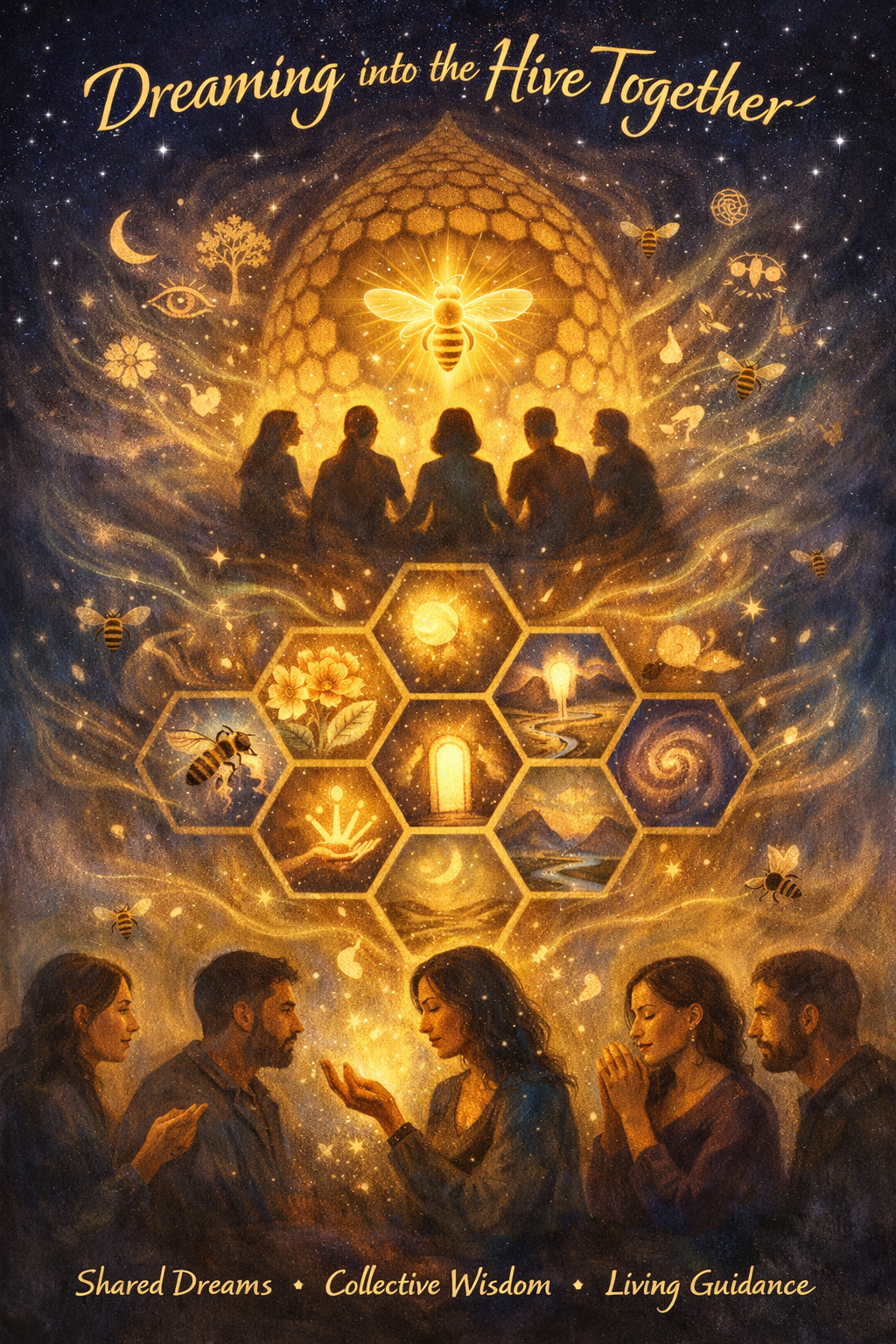
A living practice of collaborative dreaming, shared symbolism, and collective healing
Introduction: Why dream together?
Most of us were taught to treat dreams as private, random, or purely psychological—something we might mention over coffee and then forget. But dreaming is not a minor side-effect of sleep. It’s a doorway into the deeper mind: symbolic, sensory, intuitive, and often astonishingly wise.
And then there’s something even more mysterious—something many of us can feel but don’t yet fully understand:
When we dream together, something larger begins to move.
Dreaming into the Hive is a practice of entering dreamspace with shared intention—like stepping into a communal chamber of the psyche where images, feelings, and teachings can arrive through many dreamers at once. It’s not about “proving” anything. It’s about listening closely to what becomes possible when a group begins to dream as a field.
What is “Dreaming into the Hive”?
When I use the word Hive, I’m speaking to a living intelligence—an organizing principle we recognize in nature, in community, and in the psyche itself. A hive is many beings moving as one body. It’s rhythm, cooperation, instinct, and shared purpose.
Dreaming into the Hive is the act of:
- setting a shared intention before sleep
- inviting the dreamworld to respond through symbol and sensation
- returning to circle with what was received
- weaving meaning through witness, resonance, and shared reflection
Over time, the group begins to form a honeycomb of meaning—each person’s dream a cell, each symbol a thread, each share a kind of pollen carried back from another realm.
The potential we don’t fully understand (yet)
There’s a power in collaborative dreaming that isn’t easily explained by linear logic.
When people dream with a shared intention, the dreamspace can begin to feel like a shared atmosphere—a subtle field where themes echo, overlap, and weave across different lives. Sometimes this shows up as striking parallels (similar symbols arriving for multiple dreamers). Sometimes it shows up as something even more intriguing: a kind of distributed message.
It can feel as though the dreaming intelligence “shares the workload”:
- one person dreams the grief
- another dreams the medicine
- another dreams the threshold
- another dreams the next step
- another dreams the blessing
As if no one nervous system had to hold the whole transmission alone—because the Hive can deliver it through many.
Whether you name this the collective unconscious, spirit, the social mind, or something beyond our current language, the experience is often the same:
Co-dreaming creates coherence.
Key benefits and why this matters
1) Belonging that happens beneath the mask
Dream-sharing creates a rare kind of intimacy—because dreams come from the place beneath performance. When someone shares an image, a feeling, or a dream encounter, they’re offering something raw and real. That kind of witnessing builds trust fast—without forcing vulnerability.
People begin to recognize each other by essence:
“I’ve felt that landscape too.”
“I’ve met that fear.”
“I’ve heard that hum.”
This is community formed through inner truth—not personality.
2) A collective nervous system of support
Dreaming together can be profoundly regulating. When a group returns to circle, the message becomes: you don’t have to carry the unseen alone.
Sometimes the most healing moment isn’t the dream itself—it’s being met afterwards with respectful presence:
- no fixing
- no forced meaning
- no dismissal
- just witness, resonance, and care
Over time, the Hive becomes a shared sanctuary: a place where the nervous system learns safety through connection.
3) Healing that doesn’t require the old story
Dreams often work without explanation. They move through image, sensation, archetype, and symbol—the way nature teaches. In collaborative dreaming, healing can happen through:
- meeting fear as a figure rather than a life sentence
- encountering grief as an ocean, not a personal flaw
- receiving tenderness as an atmosphere, not a concept
- discovering inner resources you didn’t know you had
It’s not always “therapeutic” in the modern sense. Sometimes it’s simply restorative—because the soul is finally allowed to speak in its own language.
4) A living map that no one could receive alone
When dreams are gathered, patterns begin to reveal themselves: repeated symbols, shared thresholds, recurring themes. The group’s dreaming becomes a kind of collective compass.
Instead of one person trying to “figure everything out,” the circle becomes a honeycomb of guidance—a living map formed cell by cell.
Often the question isn’t “What does my dream mean?”
It becomes: “What is the Hive showing us?”
5) Creativity, vision, and the return of the communal imagination
Dreaming together restores something ancient: the power of shared imagination. Modern culture isolates the inner world—yet dreams are communal by nature. They speak in archetypes, instincts, and symbols that belong to all of us.
Collaborative dreaming can spark:
- creative downloads (writing, art, songs, offerings)
- visioning for projects and communities
- renewed purpose and direction
- unexpected solutions that arrive sideways (in the way dreams do)
The dreamworld doesn’t always answer with a plan.
Sometimes it answers with a seed—and the group becomes the soil.
What makes this practice different from “dream interpretation”
Dreaming into the Hive is not about forcing a meaning onto a dream.
It’s about relationship.
We listen for:
- the emotional tone
- the core image(s)
- the turning point
- the medicine (what was given, shown, or shifted)
- the resonance (where the group feels the echo)
We hold dreams gently—like sacred objects. We don’t rush to translate them into certainty. We let them work on us slowly, the way honey ferments: time, warmth, and presence.
we keep the Hive clean
Because dreamspace is tender, the container matters.
In Hive Dreaming, we practice:
- consent: share only what feels right
- confidentiality: what’s shared stays held
- non-fixing: we don’t diagnose each other
- reverence: dreams are not “content,” they are communication
- grounding: we integrate gently into waking life
This is how dreaming becomes medicine instead of spectacle.
I believe collaborative dreaming is one of the great forgotten human technologies—not mechanical, but soulful. Not about control, but about communion.
When we dream together, we may be touching a layer of mind that isn’t confined to the individual. We’re remembering a shared inner world—one that can restore belonging, reveal guidance, and bring back medicine for our lives.
If you need one line to anchor this practice, it’s this:
Collaborative dreaming may be the Hive’s way of thinking—through many minds at once.
And when we return with what we’ve received, we don’t just share dreams—
we begin to dream a new reality into being, cell by cell.
If people genuinely start to feel themselves as both the dream and the dreamer—both the experience and the one witnessing the experience—the psychological impact can be huge, and (done well) deeply stabilizing.
What it can change, psychologically
1) Less fusion with pain, more choice
When someone can be the feeling (sadness, fear, grief) and the one aware of it, they’re less likely to get swallowed by it. In therapy language, this is a move from identification (“I am anxious”) to relationship (“Anxiety is here, and I’m here too”). That tends to reduce overwhelm and increase agency.
2) Faster nervous-system regulation
The “witness” position naturally activates a regulating circuit: breath slows, the body has more space, and the threat response softens. Not because the pain disappears, but because the system stops treating it as total reality.
3) A kinder, more integrated self-concept
Experiencing “I am the thing being seen” can dissolve shame. People often realize their inner parts aren’t enemies—they’re expressions of protection, longing, loss, or unmet needs. This supports integration instead of self-rejection.
4) Increased mental flexibility and creativity
“And/both” thinking loosens rigid binaries (good/bad, right/wrong, victim/perpetrator, strong/weak). That flexibility is strongly linked to resilience. It also boosts creativity, because the mind becomes less literal and more symbolic—more dreamlike.
5) A deeper sense of meaning
When people can inhabit both sides, they often feel life as more “alive,” less mechanical. It can restore a sense of purpose and guidance, because experience isn’t just happening to them—they’re participating in it.
 Heart of Compassion